

Everyone’s talking about oil markets.
One minute, the Strait of Hormuz is open, the next it’s not.
An hour later, we’re told a peace deal is minutes away from being signed… wait, it’s not a peace deal, just a ceasefire agreement.
But didn’t we just read headlines reporting that both sides were firing on vessels? Sure, but that doesn’t count.
Again, a little later, we’re told a ceasefire deal is imminent, but it’s not.
Negotiations for that don’t come for another month. 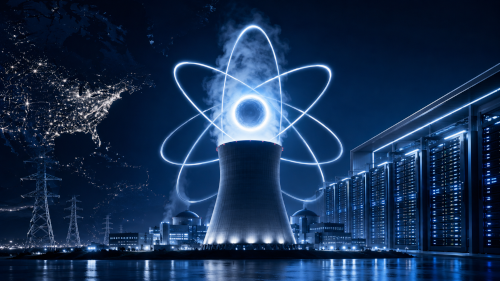
Right now it’s a Memorandum of Understanding that will open negotiations for a ceasefire, which will then lead to a peace deal.
Okay, got it.
Remind me again what the definition of insanity is?
Meanwhile, Iran and the U.S. have never been further apart on their respective red lines.
Considering how the markets have reacted time and again to this war, it’s becoming painfully clear that the real energy security crisis isn’t happening in a chokepoint in the Persian Gulf.
In the end, it’s the coming power crisis that’ll get us.
And the red flags have been waving on data center campuses across North America where power demand is growing 4x faster than the grid can handle.
The Best Free Investment You’ll Ever Make
Our analysts have traveled the world over, dedicated to finding the best and most profitable investments in the global energy markets. All you have to do to join our Energy and Capital investment community is sign up for the daily newsletter below.
Nuclear Energy’s Quiet Inflection Point
Last year, the number of data centers under construction in North America jumped 70% to record levels.
This year, they’re still building faster than anyone projected.
Every single member of Big Tech is getting in on the action. Microsoft is opening one after another, Google is signing long-term nuclear power contracts, and even Meta is locking in SMR capacity before it even exists.
But the bottleneck isn’t crude oil flowing through a strait 7,000 miles away.
It’s the kilowatt-hours available on the U.S. grid right now.
And the only infrastructure that can solve it — the only source of baseload power that runs 24/7 regardless of weather — is nuclear.
Right now, there are 94 commercially operating reactors in the U.S., with three about to restart.
Globally, we’ll see 15 new reactors come online globally by the end of the year.
Now, next-gen nuclear technology is making its debut as the first commercial licensing milestone was recently achieved for a small modular reactor in the U.S.
And while everyone’s watching oil prices spike and fall on nothing more than rumors, the nuclear sector is quietly accelerating past a structural inflection point.
The data center operators know it, as do the companies supplying our grid with power.
The fact isn’t lost on Wall Street, either.
Goldman Sachs projects data center demand could grow 160% by 2030.
The market is still pricing nuclear power like it’s 2010.
Everyone’s Watching Oil and Ignoring This Energy Crisis
Back in 2022, data centers consumed 460 terawatt-hours of electricity.
This year, that number is expected to hit more than 1,000 terawatt-hours — more than double in just four years.
For the record, that’s roughly equivalent to the entire electricity consumption of Japan.
And here’s the catch — that growth is accelerating.
Looking at the projections out of the IEA, you’ll find that global data center electricity demand could hit 1,200 terawatt-hours by 2035.
You can bet everyone’s preparing for this inevitability.
It’s the reason why Google is inking long-term power purchase agreements with nuclear utilities — Data4, a major data center operator, just locked in a 12-year Nuclear Production Allocation Contract with France’s state utility EDF for firm nuclear baseload power.
Even Meta signed a 150-megawatt PPA with Sage Geosystems for SMR capacity that doesn’t exist yet.
These deals aren’t new, dear reader, simply a continuation of what we’ve been seeing occur for the last few years.
Of course, Big Tech isn’t gambling on renewables to save them.
They’ve done the math and know full-well that the intermittency issues that plague sources like wind and solar would be a death knell for any data center they build.
Of course, the grid is already struggling.
Data centers under construction in North America jumped 70% in a single year to a record 3.9 gigawatts, cementing real future demand. Remember, this AI infrastructure is on the ground right now, being built, consuming power as we speak.
In fact, Virginia’s electric utility Dominion has warned that it needs nearly 27 gigawatts of new generation by 2039.
In some parts of the U.S., data center demand is already outpacing available capacity. That means we’ll start seeing projects delayed as the necessary infrastructure is put into place and contracting power directly from private producers because the grid can’t provide it.
Here’s where nuclear power fits in…
The U.S. operates 94 commercial nuclear reactors.
Together, they generate almost 20% of the nation’s electricity.
And for 40 years, they’ve been dismissed as expensive, obsolete, and dangerous by the energy establishment.
Suddenly, they’re the only infrastructure keeping data centers online.
But the existing fleet is just the beginning.
A few days ago, NANO Nuclear Energy announced that the U.S. Nuclear Regulatory Commission formally accepted the Construction Permit Application for the KRONOS microreactor system at the University of Illinois.
That’s the first commercially-ready microreactor design to reach this milestone.
We’re not talking about a mere prototype or pilot project — this is a commercial reactor moving into formal licensing review.
Globally, we’re looking at about 15 reactors to come online and add close to 12 gigawatts of new capacity.
Not surprisingly, China approved 10 new units with $27 billion in investment and is forecast to become the world’s largest nuclear power market by 2030.
Japan even restarted Kashiwazaki-Kariwa Unit 6 in February 2026 with 1,356 megawatts of capacity.
And here in the U.S., something unprecedented is happening — decommissioned reactors are restarting.
Remember when the Palisades Nuclear Plant in Michigan shut down in 2022 for economic reasons?
Well, Holtec International bought it, and they’re refurbishing it to come back online and supply 885 MW.
That’s the first time in U.S. history a decommissioned reactor is restarting.
We’ve talked about the Crane Clean Energy Center in Pennsylvania, which is set to restart in 2027.
Then there’s Duane Arnold in Iowa in 2029.
Combined, those three plants will add about 2.25 gigawatts of capacity — roughly 2-3% of current U.S. nuclear capacity.
Here’s what I think is going to happen…
Over the next 2 years, we’re going to see a series of announcements that the herd will treat as incremental news: capacity uprates at existing plants, license extensions at plants scheduled to close, new power purchase agreements with data center operators, and SMR projects moving from development to construction.
Each announcement will be modest, and none of them will individually move the market.
But together, they’re the revaluation of an entire sector that’s been trading as if the world will run on coal and natural gas forever.
The existing nuclear operators — the ones with plants that are licensed, operational, and connected to the grid — are going to see their earnings swell as data center operators lock in long-term power contracts at premium prices.
That’s already happening!
Meanwhile, we’ll continue to see SMR developers hit commercial milestones.
NANO Nuclear, NuScale, and Oklo are going to see their paths to revenue accelerate as utilities and data center operators move from “interested in the technology” to “we need this capacity and we’re willing to pay for it.”
The restart projects are going to demonstrate that bringing old plants back online is faster, cheaper, and less complicated than building new capacity from scratch.
And the market is going to wake up to the fact that nuclear — the energy source everyone spent 40 years dismissing — just became the infrastructure that powers the entire AI buildout.
While everyone’s watching oil futures being manipulated on a whim, the nuclear rebound is taking place in regulatory filings and utility balance sheets.
By the time the market prices it in, the easy gains will already be taken.
The nuclear revival is a marathon, not a sprint.
And the winners are already being decided.
Until next time,

Keith Kohl
 Check us out on YouTube!
A true insider in the technology and energy markets, Keith’s research has helped everyday investors capitalize from the rapid adoption of new technology trends and energy transitions. Keith connects with hundreds of thousands of readers as the Managing Editor of Energy & Capital, as well as the investment director of Angel Publishing’s Energy Investor and Technology and Opportunity.
For nearly two decades, Keith has been providing in-depth coverage of the hottest investment trends before they go mainstream — from the shale oil and gas boom in the United States to the red-hot EV revolution currently underway. Keith and his readers have banked hundreds of winning trades on the 5G rollout and on key advancements in robotics and AI technology.
Keith’s keen trading acumen and investment research also extend all the way into the complex biotech sector, where he and his readers take advantage of the newest and most groundbreaking medical therapies being developed by nearly 1,000 biotech companies. His network includes hundreds of experts, from M.D.s and Ph.D.s to lab scientists grinding out the latest medical technology and treatments. You can join his vast investment community and target the most profitable biotech stocks in Keith’s Topline Trader advisory newsletter.


